The idea, in plain language
Run the railway like a well-timed freeway
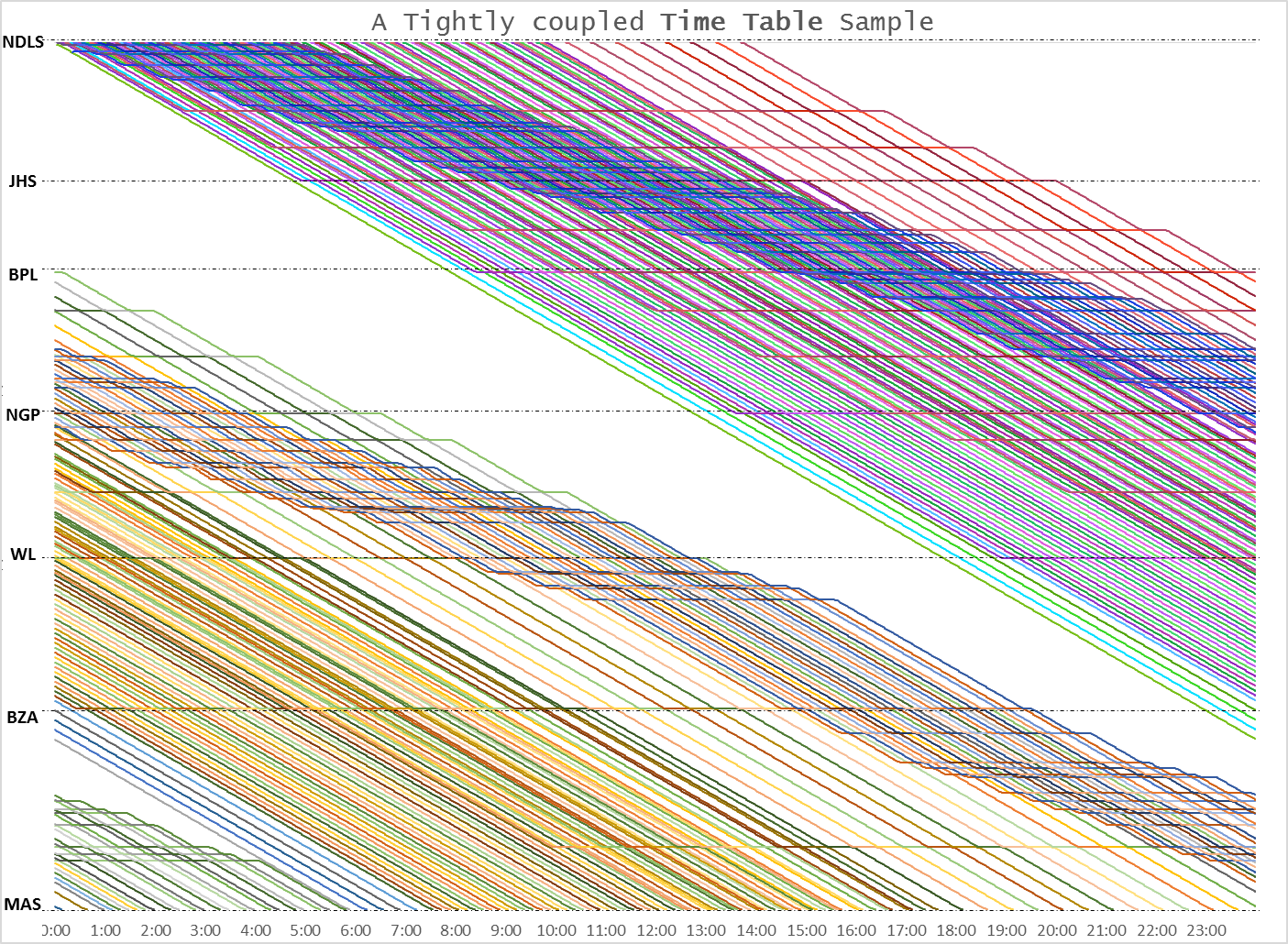
Today, fast and slow trains share the same line and constantly get in each other's way — a single express stuck behind a slow goods train holds up everything behind it. The fix: keep the main line moving at one steady speed, give every train a precise 5-minute time slot, and let trains that need to stop pull aside onto a station loop — so the main line never gets blocked.
A slot-based timetable that keeps the main line moving at one steady speed lifts a saturated corridor toward ~500 trains a day on existing rails, and proven on a computer before a single train moves.
Think of a busy staircase. If everyone climbs at their own pace, the slowest person creates a jam behind them. But if everyone moves at one steady rhythm — and anyone who wants to pause steps onto a landing to let others by — far more people use the same staircase, calmly and safely. That's what slot-based timetabling does for a railway line: the stairs (the main line) stay flowing; the pausing happens on the landings (the loops).
1
One steady speed
Every train on the main line runs at the section's full through-speed, evenly spaced five minutes apart — like vehicles on a free-flowing expressway.
2
Stop on the side
A train that must halt pulls onto a lengthened station loop, stops there, and rejoins — so it never blocks the train behind it.
3
Take a later slot
Because stopping costs a little time, that train simply slots back in behind — faster trains sail past at full speed. Fair, predictable, and built into the plan.
4
Stay on time
A live readout shows each driver how many seconds they are ahead of or behind schedule — our optional WhatsComing app, working alongside the Railways' Kavach safety system — so every train holds its slot to the second.